|
 |





Greil Marcus's 1975 published book Mystery Train - "the finest examination to date of American popular music" - was a brilliant study of rock and roll and American Culture. It contained several key sections: This Elvis main section was 56 pages and not only looked at Elvis performing live in 1972 (at the time Marcus was writing his book) but also back to his key SUN Records releases. At the time it was noted as .. "regarded by many as the most insightful writing we have about Presley." Here are a few selected paragraphs from the chapter on Elvis. Greil Marcus' writing captures an essence often missed by other authors..
ELVIS: Presliad .. Elvis Presley is a supreme figure in American life, one whose presence, no matter how banal or predictable, brooks no real comparisons. He is honored equally by long-haired rock critics, middle-aged women, the City of Memphis (they finally found something to name after him: a highway), and even a president. Beside Elvis, the other heroes of this book seem a little small-time. If they define different versions of America, Presley's career almost has the scope to take America in. The cultural range of his music has expanded to the point where it includes not only the hits of the day, but also patriotic recitals, pure country gospel, and really dirty blues; reviews of his concerts, by usually credible writers, sometimes resemble Biblical accounts of heavenly miracles. Elvis has emerged as a great artist, a great rocker, a great purveyor of shlock, a great heart throb, a great bore, a great symbol of potency, a great ham, a great nice person, and, yes, a great American.
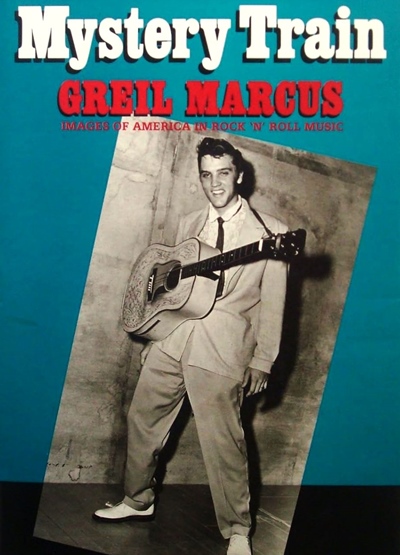
Elvis was thirteen when the family left Tupelo for Memphis in 1948, a pampered only child; ordinary in all respects, they say, except that he liked to sing. True to Chuck Berry's legend of the Southern rocker, Elvis's mother bought him his first guitar, and for the same reason Johnny B. Goode's mama had in mind: keep the boy out of trouble. Elvis sang tearful country ballads, spirituals, community music. On the radio, he listened with his family to the old music of the Carter Family and Jimmie Rodgers, to current stars like Roy Acuff, Ernest Tubb, Bob Wills, Hank Williams, and to white gospel groups like the Blackwood Brothers. Elvis touched the soft center of American music when he heard and imitated Dean Martin and the operatics of Mario Lanza; he picked up Mississippi blues singers like Big Bill Broonzy, Big Boy Crudup, Lonnie Johnson, and the new Memphis music of Rufus Thomas and Johnny Ace, mostly when no one else was around, because that music was naturally frowned upon. His parents called it "sinful music," and they had a point — it was dirty, and there were plenty of blacks who would have agreed with Mr. and Mrs. Presley — but Elvis was really too young to worry. In this he was no different from hundreds of other white country kids who wanted more excitement in their lives than they could get from twangs and laments — wanted a beat, sex, celebration, the stunning nuances of the blues and the roar of horns and electric guitars. Still, Elvis's interest was far more casual than that of Jerry Lee Lewis, a bad boy who was sneaking off to black dives in his spare time, or Carl Perkins, a musician who was consciously working out a synthesis of blues and country. The Presleys stumbled onto welfare, into public housing. Vernon Presley found a job. It almost led to the family's eviction, because if they still didn't have enough to live on, they were judged to have too much to burden the county with their troubles. Elvis was a loner, but he had an eye for flash. He sold his blood for money, ushered at the movies, drove his famous truck, and divided the proceeds between his mother and his outrageous wardrobe. Looking for space, for a way to set himself apart. Church music caught moments of unearthly peace and desire, and the strength of the religion was in its intensity. The preacher rolled fire down the pulpit and chased it into the aisle, signifying; men and women rocked in their seats, sometimes onto the floor, bloodying their fingernails scratching and clawing in a lust for absolute sanctification. No battle against oppression, this was a leap right through it, with tongues babbling toward real visions, negating stale red earth, warped privvies, men and women staring from their swaybacked porches into nothingness. It was a faith meant to transcend the grimy world that called it up. Like Saturday night, the impulse to dream, the need to escape, the romance and the contradictions of the land, this was a source of energy, tension, and power. Elvis inherited these tensions, but more than that, gave them his own shape. It is often said that if Elvis had not come along to set off the changes in American music and American life that followed his triumph, someone very much like him would have done the job as well. But there is no reason to think this is true, either in strictly musical terms, or in any broader cultural sense. It is vital to remember that Elvis was the first young Southern white to sing rock 'n' roll, something he copied from no one but made up on the spot; and to know that even though other singers would have come up with a white version of the new black music acceptable to teenage America, of all who did emerge in Elvis's wake, none sang as powerfully, or with more than a touch of his magic. Even more important is the fact that no singer emerged with anything like Elvis's combination of great talent and conscious ambition, and there is no way a new American hero could have gotten out of the South and to the top—creating a whole new sense of how big the top was, as Elvis did—without that combination. The others Perkins, Lewis, Charlie Rich —were bewildered by even a taste of fame and unable to handle a success much more limited than Presley's. If Elvis had the imagination to come up with the dreams that kept him going, he had the music to bring them to life and make them real to huge numbers of other people. It was the genius of his singing, an ease and an intensity that has no parallel in American music, that along with his dreams separated him from his context...
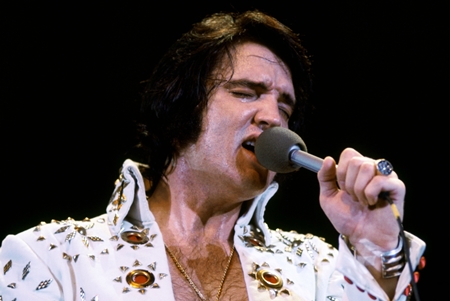
1972 - FINALE These days, Elvis is always singing. In his stage-show documentary, Elvis on Tour, we see him singing to himself, in limousines, backstage, running, walking, standing still, as his servant fits his cape to his shoulders, as he waits for his cue. He sings gospel music, mostly; in his private musical world, there is no distance at all from his deepest roots. Just as that personal culture of the Sun records was long ago blown up into something too big for Elvis to keep as his own, so the shared culture of country religion is now his private space within the greater America of which he has become a part. And on stage? Well, there are those moments when Elvis Presley breaks through the public world he has made for himself, and only a fool or a liar would deny their power. Something entirely his, driven by two decades of history and myth, all live-in-person, is transformed into an energy that is ecstatic — that is, to use the word in its old sense, illuminating. The overstated grandeur is suddenly authentic, and Elvis brings a thrill different from and far beyond anything else in our culture; like an old Phil Spector record, he matches, for an instant, the bigness, the intensity, and the unpredictability of America itself. It might be that time when he sings "How Great Thou Art" with all the faith of a backwoods Jonathan Edwards; it might be at the very end of the night, when he closes his show with "Can't Help Falling in Love," and his song takes on a glow that might make you feel his capacity for affection is all but superhuman. Whatever it is, it will be music that excludes no one, and still passes on something valuable to everyone who is there. It is as if the America that Elvis throws away for most of his performance can be given life again at will. At his best Elvis not only embodies but personalizes so much of what is good about this place: a delight in sex that is sometimes simple, sometimes complex, but always open; a love of roots and a respect for the past; a rejection of the past and a demand for novelty; the kind of racial harmony that for Elvis, a white man, means a profound affinity with the most subtle nuances of black culture combined with an equally profound understanding of his own whiteness; a burning desire to get rich, and to have fun; a natural affection for big cars, flashy clothes, for the symbols of status that give pleasure both as symbols, and on their own terms. Elvis has long since become one of those symbols himself. Elvis has survived the contradictions of his career, perhaps because there is so much room and so much mystery.. he takes his strength as well from the humility, the piety, and the open, self-effacing good humor that spring from the same source: I am better than no man. Elvis proves then that the myth of supremacy for which his audience will settle cannot contain him; he is, these moments show, far greater than that. So perhaps that old rhythm of the Sun records does play itself out, even now. Along with Robert Johnson, Elvis is the grandest figure in the story I have tried to tell, because he has gone to the greatest extremes: he has given us an America that is dead, and an unmatched version of an America that is full of life.
|
|