RCA 's Steve Sholes was similarly concerned, as this sure wasn't the "Sun Sound" that he had hoped Elvis would be recording. RCA's New York office even suggested that Steve Sholes return to Nashville and cut something more chart-worthy.
Rock'n'roll fans can be thankful that Elvis however understood the magic that had just been created and had faith in its release.
In Liverpool, UK, The Beatles' John Lennon knew that Elvis' new 1956 45rpm would change everything...
.. “When I first heard ‘Heartbreak Hotel’ I could hardly make out what was being said. It was just the experience of hearing it and having my hair stand on end. We’d never heard American voices sing like that, they'd always sang like Sinatra or enunciated very well.
Suddenly there’s this sort of hillbilly hiccup on tape echo and all this bluesy background stuff going on. And we didn’t know what Elvis was singing about ….. to us it just sounded as a noise that was great.”
"Nothing really affected me until I heard Elvis. If there hadn't been an Elvis, there wouldn't have been the Beatles."
Heartbreak Hotel was released by RCA on January 27, 1956 - It was as if the world had been holding its breath and waiting for Elvis Presley.
Too often calendar years are described as 'seismic', but 1956 – the year that marked Elvis Presley's first major record release – really did see the world teetering on the brink of change.
On the global stage, Britain's role as a world power was undermined by the public humiliation of the Suez Crisis, in the East Russian tanks would roll across the Hungary border crushing the nascent rebellion beneath their tracks. The Cold War returned to its familiar icy stasis, while in Cuba, the guerrilla forces of Fidel Castro waged war against the corrupt regime of President Batista.
In the theatre, John Osborne's Look Back In Anger delivered the first thrust against the conservative traditions of British stage drama, while My Fair Lady opened on Broadway, and was hailed as the best musical ever. Television was still a relative newcomer, but British viewers were now luxuriating in the choice of not one but two television channels, while across Europe nations united to watch the first Eurovision Song Contest.
In America, President Eisenhower comfortably beat Democrat Adlai Stevenson in the race for the White House – proving that the United States was in no mood for change just yet. The nation was happy enjoying its burgeoning baby boom and the country's status as a consumer paradise. But Stevenson's defeat made one young Democratic senator, by the name of John F. Kennedy, determined to run for President in 1960.
Way down in Alabama, a weary black maid called Rosa Parkes refused to give up her seat on a Montgomery bus to a white passenger and inadvertently triggered the fight for Civil Rights. The movement, spearheaded by the Reverend Martin Luther King, soon grew into a nationwide campaign that would divide America for the next decade. In contrast, few readers of American newspapers even bothered with the news that 1956 also saw the last French troops leaving Vietnam.
This was the world into which Elvis Presley hurtled at the very beginning of 1956.
The first song Elvis cut on 10 January 1956 at his debut session for RCA was Ray Charles' 'I Got A Woman'. Later that day at the company's Nashville Studio, after only seven takes, he nailed another song – one that had been pitched to him the previous year and that would be released within weeks as his debut single on RCA, the label he would remain with for the rest of his life. The song was 'Heartbreak Hotel'.
It was while performing in Jacksonville, Florida in 1955 that Elvis had met schoolteacher and sometime songwriter Mae Boren Axton, who convinced him that she could write him his first million-seller. Later that year, Mae's songwriting partner Tommy Durden showed her a newspaper story in the Miami Herald about an unknown suicide whose one-line epitaph read simply, "I walk a lonely street". Twenty minutes later 'Heartbreak Hotel' came into the world.
A few weeks later Mae Axton played the demo to Elvis, who agreed to record it. Mae then pitched the song to Colonel Parker who also agreed to take it, but only on the condition that his boy be given a one-third composer credit and royalty.
Mae consented, and then drifted out of the Elvis story – except for the postscript that her son, Hoyt Axton, also went on to enjoy a successful career writing songs, including 'Never Been To Spain', which Elvis recorded in 1972.
(Right, Elvis with country performer and Charlene Arthur and Mae Axton) |
 |
The brief at RCA's Nashville Studio in January 1956 was to replicate the sound Sam Phillips had previously conjured up in Memphis.
All the same ingredients were there, but this time there was enormous pressure on the musicians to try and recapture something that had been magical, but momentary, only months before.
At Sun Records it had all been fun. For Elvis, goofing around on his beat-up acoustic guitar came as a welcome relief front his job as a truck driver. Seasoned Sun veterans Scotty Moore and Bill Black joined in spontaneously, although not really sure how or what they were doing – or why they were doing it.
Meanwhile, in the control room, Sam Phillips rocked with delight, and tried to catch that fleeting moment on tape. Now, in Nashville, things were a lot more serious: there was a whole heap of speculation and interest – not to mention money –riding on the 21-year-old Presley's shoulders. |
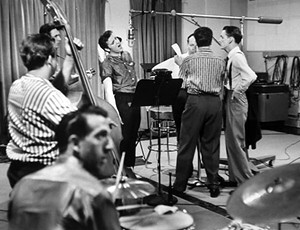 |
In the RCA control room that day were studio engineer Bob Ferris, Tom Parker, Mae Boren Axton, Jimmy Day (Floyd Cramer’s musical partner) and RCA's Steve Sholes.
Shane Brown noted in his sessions book 'Reconsider Baby' A listener's Guide ,
"Intriguingly, like so much of Elvis’s output, the recording really doesn’t fit into any particular genre of popular music. It has elements of blues, and elements of rock, but then Floyd Cramer’s piano solo in the instrumental break is almost jazzy in nature. Lyrically, it’s one of the most morbid songs Elvis ever recorded and, a little like the earlier Blue Moon, the master take has an almost eerie feel to it. This is an effect partly provided by the fact that so much reverb was added to Elvis’s vocals that it makes him sound as if he is singing within an aural fog (and that’s not a negative in this instance). The song transcended boundaries; it was a number that spoke to the teenagers of 1956 but could also have provided part of the soundtrack for a 1940s film noir."
While author Tony Plews in his amazing 700-page book 'Walk A Lonely Street: Elvis Presley, Country Music & The True Story of Heartbreak Hotel' comments..
'From the opening notes, sung acapella (Elvis had lifted the key from c to e), it was clear this was a song unlike any other on the charts, be it pop, country or blues; and although it was not rock ‘n’ roll music per se (you couldn’t dance to it), it carried all of the rebelliousness and inherent sexiness of that new genre. It sounded savage, primal, and it came straight from the gut. It was the most prepared he’d been with any recording since “That’s All Right”. He had worked out which syllables to stretch and which beats to accentuate. Taking his cues from “Only You”, he’d established how to mangle words and add nonsensical sounds to the lyrics, transforming “I’ll be so lonely, baby” into something like “I’ll be-kuh so lonely, bay-beh”, which added to the rhythm while making the narrative yet more mysterious. He had streamlined some of the chorus pronouns, removing the “we” from the final line, ensuring it was more radio-friendly. But the one lyric that still remained unfixed in his mind was “pray to die”, and he wondered whether it was just too deep: but on take one it was present and correct.
For such a stark, unornamented song, he’d gone to great lengths to assemble the arrangement, but this was indicative of its importance to him. Even on the early takes, he spat out the first verse with absolute and shocking conviction, the band punctuating each line with a perfectly timed double strike (slightly behind the beat in best Fats Domino style), and as he slid into the chorus, Elvis was almost naked vocally, backed purely by the double-echo and Bill’s descending bass. Aside from the “kuh” affectations, his diction was immaculate, especially on the title words'.
The second verse was equally powerful, and on the chorus D.J. (on brushes) and Scotty Moore crept in to fill out the sound. By the third chorus, Chet Atkins was strumming and Floyd Cramer had added pitter-patter keyboard figures to complete the picture. The fourth verse and chorus maintained the full band, but it was the unrehearsed pianist who came unstuck during the following instrumental passage. Scotty carried the first part of this section leaning heavily on the staccato notes Elvis had suggested (as per his conversation with Mae Axton), but Floyd couldn’t find his mojo, having literally just learned the song. For the fifth verse, Elvis had decided to repeat the second, but instructed the band to add a flourish, D.J. again using his cymbals, to accentuate the finale.
The studio was hushed as the last note tailed off. Mae smiled. Steve raised his eyebrows. Elvis asked for a playback. The sound caught him unawares: the heavy echo wasn’t necessarily what he’d heard in his head during the weeks of preparation, but he recognised that it brought something otherworldly to the recording.'
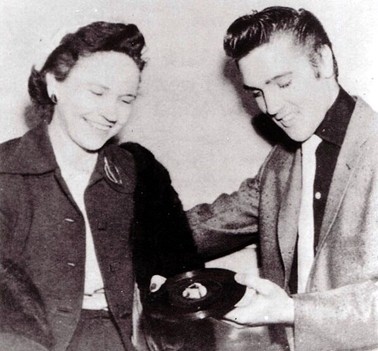 |
Elvis with composer Mae Boren Axton after the successful release of Heartbreak Hotel
To capitalise on the growing media interest in Elvis, RCA rushed out 'Heartbreak Hotel' on January 27 1956.
Billboard called it: 'a strong blues item wrapped up in his usual powerful style and a great beat'. The review may have held Elvis' attention briefly, but he was too busy – touring Texas and Louisiana, before flying to New York to record – to rest on his laurels for long.
The day after 'Heartbreak Hotel' was released, Elvis made his national TV debut on Stage Show, but curiously didn't perform his new single. It was to be a month before 'Heartbreak Hotel' entered the American charts, at No.68 on 3 March 1956; and it took a further two months for the record – Elvis' first release on a major record label – to make it all the way.
'Heartbreak Hotel' finally reached No.1, deposing Les Baxter's 'The Poor People Of Paris', on 5 May 1956.
.
In Britain, 'Heartbreak Hotel' emerged as a 78rpm recording on His Master's Voice, the label that had earlier declined the option to release any of Elvis' Sun singles; and when New Musical Express reviewed the record, credited to 'Elvis Presley with rhythm accompaniment', it lamented: "If you appreciate good singing, I don't suppose you'll manage to hear this disc all through".
Not for the first time, NME's comments apparently fell on deaf ears and Elvis Presley made his UK chart debut on 12 May 1956, when 'Heartbreak Hotel' entered the Hit Parade at No. 15. Other chart positions that week were occupied by Winifred Atwell, Dean Martin and Alma Cogan.
'Heartbreak Hotel' eventually reached No.2 in the UK, kept off the top slot by Ronnie Hilton's 'No Other Love' but although Elvis failed to make it to No. I on this occasion, 'Heartbreak Hotel' was without doubt the fusillade that launched the rock'n'roll rebellion in Britain. |
 |
Bill Haley may have rocked around the clock a little earlier, but time was already telling on the former country and western singer – Haley was just too chubby, too cosy, to be a real teenage idol. 'Heartbreak Hotel' on the other hand, was an urgent and sensual clarion call that reached out to a whole generation.
Youngsters, chafing against the idea of being little more than pint-sized versions of their parents, found little to identify with in the other popular music of the time; but when Elvis took that walk down lonely street to 'Heartbreak Hotel' he spoke straight to the hearts of a previously silent, disenfranchised generation.
Right from the beginning, the record grabbed listeners by the throat: Scotty Moore's guitar raged and rocked; Elvis' vocal swaggered, but also reached out with the longing of those lyrics. 'Heartbreak Hotel' was full of alienation, loneliness and despair.
And the kids absolutely loved it. In their millions.
If there had been a rock'n'roll hero previously, it was James Dean, who died in a car crash three months before Elvis recorded 'Heartbreak Hotel'. The actor only lived to see one of his three films released, but in the tragic aftermath of his death, the cult of James Dean had flourished.
Youngsters on both sides of the Atlantic found solace in James Dean's moody, misunderstood martyr in Rebel Without A Cause, but they knew that after 'Giant' there would be no more Dean films. And looking around for another idol, they happened upon that record, that voice, that man ... The newly identified teenagers of the 50s had, at last, found their role model.
(Right;Elvis and his Gold Record for Heartbreak Hotel) |
 |
For years afterwards, 'Heartbreak Hotel' defined Elvis Presley – the echo-soaked voice, the plaintive lament of the singer down at the end of lonely street, the potent sexual promise offered to broken-hearted lovers.
'Heartbreak Hotel' marked the beginning for Elvis Presley, but the success of that record and its singer also marked the end of an era for the popular music industry. And, in turn, for the wider world outside
Article by Patrick Humphries from the 2002 book 'Elvis the #1 Hits'
Edited & images by Piers Beagley.
-Copyright EIN January 2011 - Update January 2026.
EIN Website content © Copyright the Elvis Information Network.
Click here to comment on this article
'1956, Elvis Presley’s Pivotal Year': In 2011 TIME magazine featured this article by SONY/FTD's music producer and consultant Roger Semon. The article helped explain what the 2011 deluxe box-set 'Young Man With The Big Beat' was all about.
... "In the mid-1950s, the post-war Eisenhower era of social conformity in America was at its peak, and musically, the most threatening image appeared to be Bill Haley’s kiss-curl as he sang “Rock Around The Clock.” That all changed on Jan. 28, 1956, when a raw and electric Elvis Presley made his breakthrough on the CBS program Stage Show. Presley’s good looks, sensuous moves and mesmerizing voice made him a sensation overnight. But it wasn’t until a third appearance on the show that Presley truly challenged the status quo. On Feb. 11, the singer performed “Heartbreak Hotel” and by April, the single would be #1 on the Billboard chart. At last, teenagers had music of their own to swoon over while their parents continued listening to Frank Sinatra and Mario Lanza....
Click HERE for the full article and fabulous Elvis Photos.
(Spotlight; Source;Time/ElvisInfoNet)
|
 |
'Orgies and Orgasms: Presley in the Press 1956'- an in-depth Spotlight: By the beginning of 1956, everything was in place for Elvis Presley to burst onto the national and international music scene. Within weeks of his signing to major label RCA he would record Heartbreak Hotel, his first single for RCA and his first to reach number 1 in the U.S. charts, and then, at the end of January 1956, he would appear on national television for the first time.
Despite all of the success that 1956 would bring Elvis, with three singles and two albums reaching the top spot in the U.S. charts, the year would also prove to be a difficult one when it came to his treatment in the national and international press.
Mainstream media published reviews such as...
"Every girl watching him sees herself as Elvis’ partner in his fantastic writhing orgy"
and "Presley is suggesting he is about to have a self-induced orgasm!"
So, let’s go back in time and examine how a single television performance in June 1956 resulted in a change of attitudes towards Elvis within the media from little more than curiosity about the new phenomenon to downright hostility and revulsion.
Back in 2018 EIN contributor Shane Brown investigated the phenomenon of Elvis in 1956 - and what the media made of this new, and middle-America shocking, entertainer. - It's essential reading
(Spotlight, Source;ShaneBrown/ElvisInformationNetwork) |
 |